
Trump Accounts: A New Savings Vehicle for the Next Generation
An informational overview of the newly launched federal savings program for children.
Defining the Account
A Trump Account is a new type of individual retirement account established for children under the One Big Beautiful Bill Act, signed into law in July 2025.1 The account functions as a hybrid: it holds investments the way a traditional IRA does, but it is opened on behalf of a minor the way a 529 plan or custodial account is. Contributions grow tax-deferred while the child is young, and the account converts into a standard traditional IRA once the beneficiary turns 18.1 For families who already use 529 plans for education savings or custodial accounts for general transfers, a Trump Account adds a third option built specifically around long-term, retirement-oriented growth rather than near-term spending. A qualified financial advisor can help sort out how a Trump Account might sit alongside those existing vehicles, since the right mix depends heavily on a family’s broader savings goals and time horizon.
Eligibility and the Pilot Contribution
The account is available to any child who has a Social Security number and who has not yet turned 18 by the end of the calendar year in which the account is opened.1 A parent, legal guardian, or other authorized individual establishes the account on the child’s behalf by submitting IRS Form 4547, either alongside a tax return or directly through an IRS online account.1 Separately, the program includes a pilot federal contribution of $1,000 for children born between January 1, 2025, and December 31, 2028, provided the child is a U.S. citizen with a valid Social Security number.1 Children born before 2025 can still have a Trump Account opened for them and receive the same tax treatment, but they are not eligible for the pilot deposit.1
How the Account Functions
Once opened, a Trump Account can accept after-tax contributions from parents, family members, employers, and certain other sources. Trustees are required to have procedures in place to monitor and enforce the $5,000 yearly contribution limit, preventing any contribution from being accepted if it would push that threshold. At launch, the Treasury Department assigns the custodian for each account rather than allowing families to select their own financial institution; families gain the ability to transfer the balance to a brokerage of their choosing only after the account has been established and initially funded.1 The period between account establishment and the year the beneficiary turns 18 is treated as a distinct “growth period” under the statute, during which the account is subject to special rules that do not apply to ordinary IRAs, including restrictions on eligible investments and a general prohibition on distributions.
What that growth period looks like in practice is easiest to see in the aggregate, since the pilot deposit and any private contributions simply accumulate as principal until the beneficiary turns 18. The chart below shows a purely hypothetical build-up of contributions only, with no investment growth applied, so families can see what could go in before turning to an advisor for what it could grow to under a given investment approach.
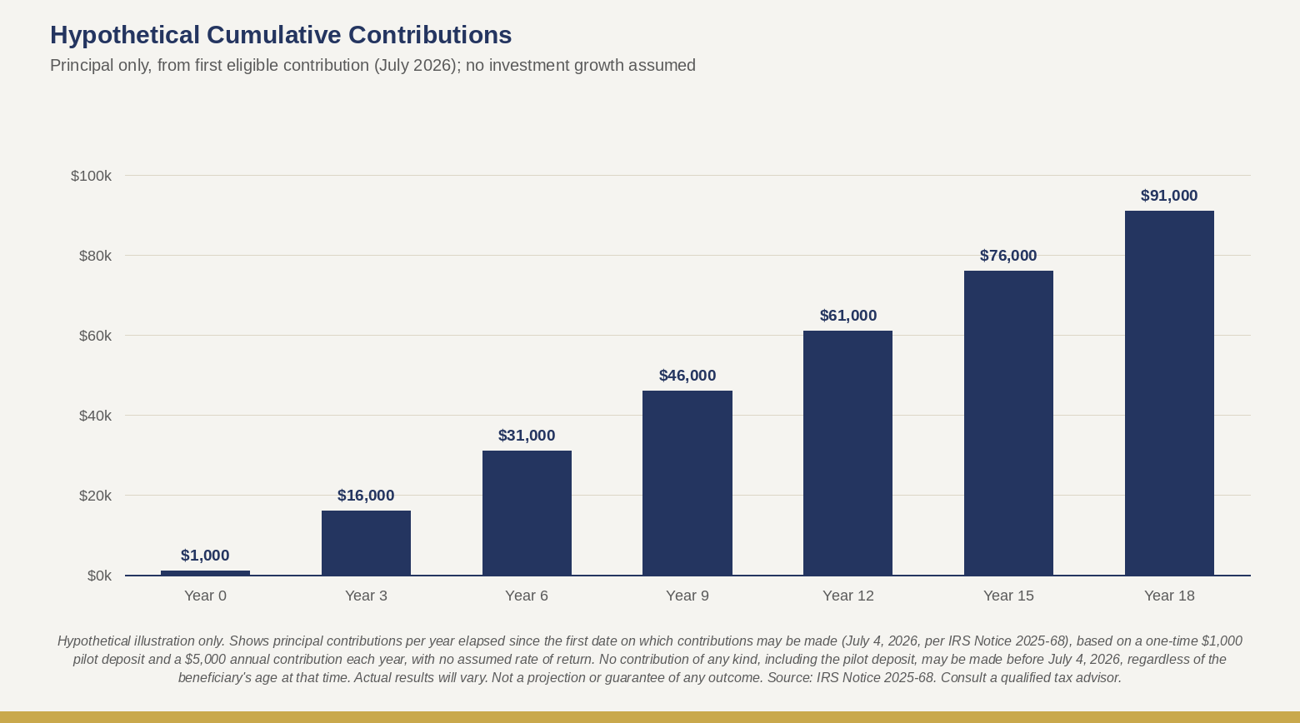
The chart reflects contributions alone, not investment performance, since how those dollars grow over the course of the growth period depends on the investment options ultimately available within the account. That is a separate question worth raising directly with a financial advisor once the account is funded.
Where This Fits Among Other Vehicles
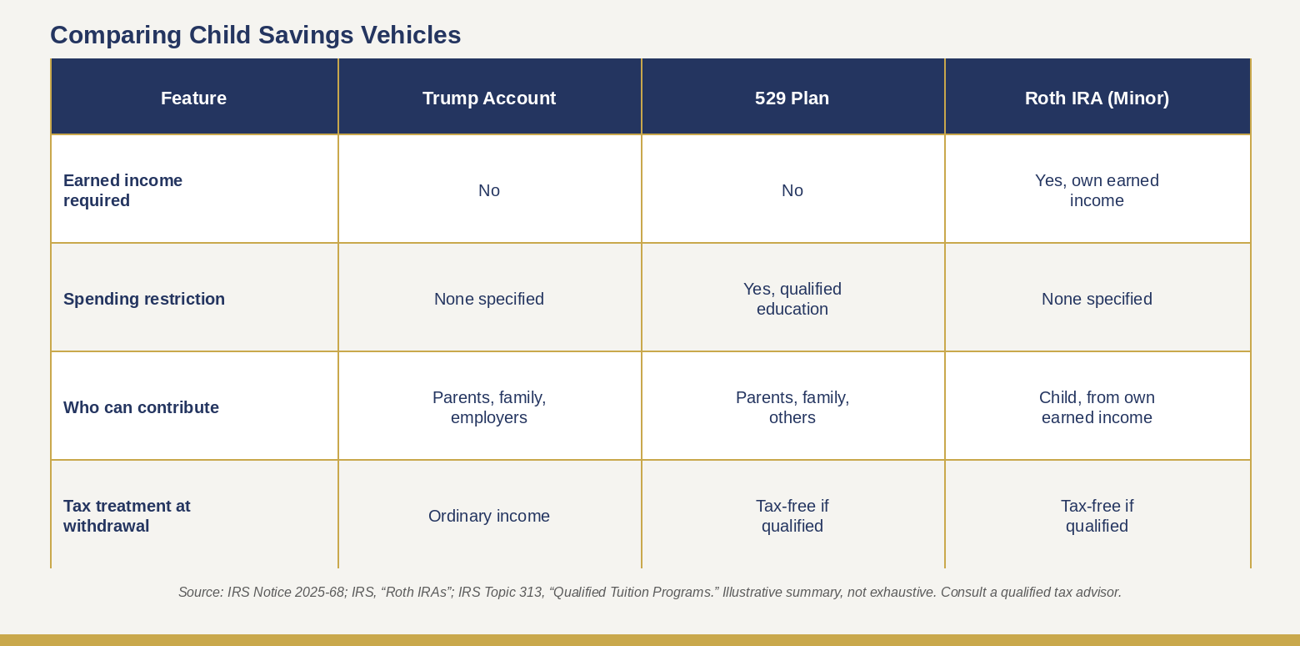
There is often a comparison raised between a Trump Account, a 529 plan, and a Roth IRA opened for a working teenager, but the differences are structural rather than cosmetic. A 529 plan is funded with after-tax dollars and grows tax-free, but withdrawals are only tax-free when used for qualified education expenses. A Roth IRA for a minor requires the child to have earned income in the year of the contribution, and the contribution cannot exceed that earned income. A Trump Account requires neither an education-spending restriction nor an earned-income test: contributions can be made by parents, relatives, or employers regardless of whether the child has any income of their own, and the funds are not earmarked for a specific future expense. Where a 529 plan is purpose-built for tuition and a Roth IRA is purpose-built for a working teen’s own retirement savings, a Trump Account is closer to a general-purpose, tax-deferred head start that only becomes retirement-specific once it converts at 18. None of these vehicles is inherently superior to the others; each is suited to a different funding source and a different intended use.
The table below lays out these structural differences side by side. A tax or financial advisor can help translate this comparison into a decision that fits a given family’s funding sources and goals.
The Conversion at Eighteen
The mechanics of what happens at age 18 are central to understanding the account, since the growth period rules fall away and the account becomes a standard traditional IRA governed by the same rules that apply to any adult-owned IRA. At that point, the now-adult beneficiary takes full control of the account, the investment restrictions that applied during the growth period no longer apply, and ordinary IRA contribution and distribution rules take over, including the additional tax that generally applies to early withdrawals before age 59 and a half, absent an exception such as a first-time home purchase or qualified education expenses. Because the account arrives at adulthood already structured as a traditional IRA, the beneficiary does not need to open a new account or complete a rollover to begin using it as a retirement vehicle.
Tax Implications
Contributions to a Trump Account do not carry a tax deduction in the year they are made, and the annual limit on contributions from parents, relatives, and other private sources is $5,000 per year for 2026 and 2027, subject to cost-of-living adjustments in later years.1 Employers may contribute up to a separate limit on behalf of an employee’s dependent, and neither the pilot deposit nor qualifying government or charitable contributions count against the private contribution cap.1 The tax treatment that follows is where the three vehicles diverge most. A Roth IRA’s qualified distributions are tax-free, since contributions were already taxed going in and the earnings come out tax-free as well.1 A 529 plan’s distributions are not taxable when used to pay qualified higher education expenses, though a portion of the earnings becomes taxable if a distribution exceeds those expenses.2 Once a Trump Account converts to a traditional IRA at 18, withdrawals are taxed as ordinary income in the same manner as any traditional IRA distribution, since the account never received the Roth-style after-tax treatment that produces tax-free withdrawals. In practical terms, the Trump Account’s appeal is not a superior tax outcome. It is broader access: no earned-income requirement, no education-spending restriction, and a federal seed deposit for eligible children, in exchange for eventual ordinary-income taxation rather than the tax-free withdrawals available through a Roth IRA or a 529 plan used for its intended purpose.
The Forward-Looking Picture
Substantial parts of the program remain subject to further IRS guidance, including final regulations that had not yet been issued as of the most recent proposed rulemaking.1 Questions still open at launch include the precise timeline for custodial transfers to outside brokerages and how investment options within the Treasury-assigned custodian will be structured before that transfer occurs. Contribution limits and program parameters are also subject to future legislative or regulatory change, and families should confirm current figures directly with irs.gov rather than relying on any fixed number over time. What is durable is the underlying structure: a tax-deferred account established in childhood that converts into a standard IRA at adulthood. How that structure fits into a given family’s plans, alongside existing college savings, taxable accounts, or other IRAs already in place, is a question worth bringing to a qualified tax or financial advisor rather than answering from a single account’s features alone. For more information, please go to https://trumpaccounts.gov/.
Sources
1 Internal Revenue Service, Notice 2025-68, irs.gov/pub/irs-drop/n-25-68.pdf; Internal Revenue Service, “Trump Accounts,” irs.gov/trumpaccounts; Internal Revenue Service, “Roth IRAs,” irs.gov/retirement-plans/roth-iras.
2 Internal Revenue Service, “Topic no. 313, Qualified tuition programs (QTPs),” irs.gov/taxtopics/tc313.
Disclosure
This material is provided for general informational and educational purposes only. It does not constitute investment, tax, or legal advice, nor is it a recommendation to buy, sell, or hold any security or to pursue any particular strategy, and does not create a fiduciary relationship. It does not take into account the investment objectives, tax situation, or financial circumstances of any individual. Any figures, calculations, or examples used are for illustration only and do not represent actual client results or investment performance. Information is believed to be accurate as of the date of publication and is subject to change without notice.
Chatham Capital Group, Inc. is an SEC-registered investment adviser headquartered in Savannah, Georgia. Registration does not imply a certain level of skill or training. A copy of Chatham Capital Group's Form ADV Part 2A is available at adviserinfo.sec.gov. A copy of Chatham Capital Group's Form CRS is available on our website here .
Figures and thresholds governed by the Internal Revenue Code, including contribution limits and other annually adjusted amounts, change periodically. Readers should consult https://www.irs.gov/ for current figures and a qualified tax or legal advisor regarding their specific situation.
© Chatham Capital Group, Inc. All rights reserved.