
Inherited Retirement Accounts: What the New Rules Require
How the SECURE Act’s final regulations reshape the distribution timeline for beneficiaries of IRAs and retirement plans
For most of the past few decades, inheriting a retirement account came with a quiet advantage. A beneficiary could stretch withdrawals over their own life expectancy, sometimes drawing down a modest amount each year for thirty or forty years. That approach let the account keep growing tax deferred while the original decedent’s savings passed gradually to the next generation.
The Setting Every Community Up for Retirement Enhancement Act (SECURE Act), signed into law in 2019, ended that approach for most non-spouse beneficiaries[1]. In its place, Congress created a fixed distribution window: most designated beneficiaries must now empty the inherited account by December 31 of the tenth year following the original decedent’s death[2], though a handful of beneficiary categories, covered later in this piece, are exempt from that deadline entirely. What took years to resolve was a narrower question: does the beneficiary have to withdraw something every year during that decade, or can they wait and take it all at once in year ten?
The Decedent’s Age at Death Decides the Rule
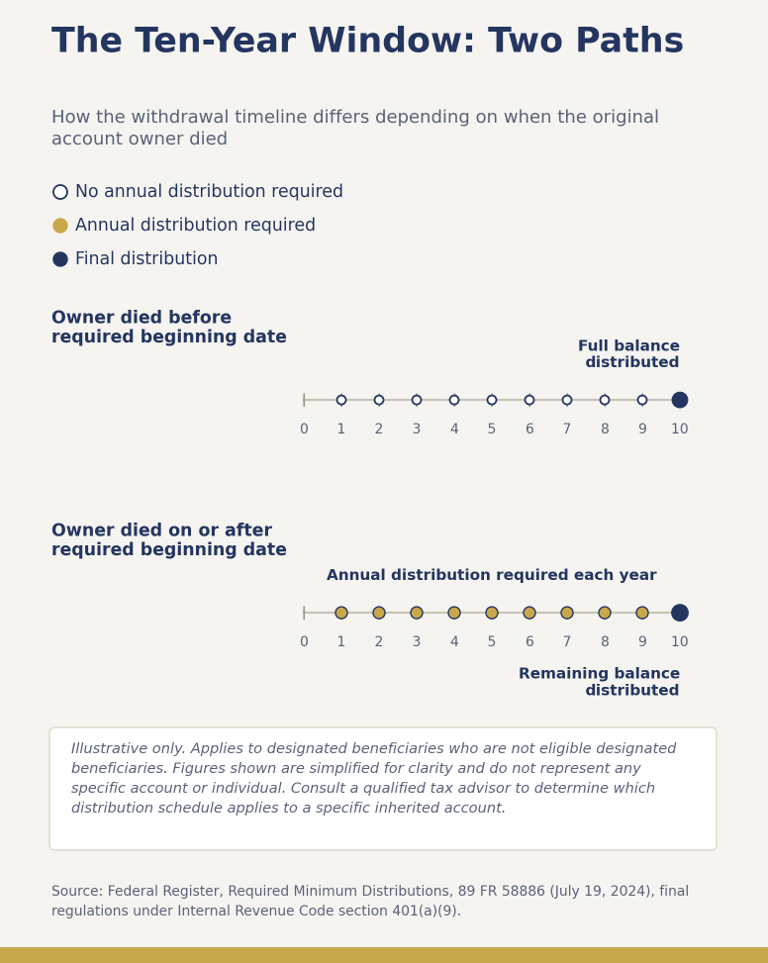
The answer turns on the decedent’s required beginning distribution date: April 1 of the year after they reached age 73, or 75 for those born in 1960 or later[3]. The Treasury Department and the IRS resolved the annual withdrawal question in final regulations issued in July 2024, effective for distribution years beginning in 2025[4]. If the original account decedent died before their required beginning distribution date, the beneficiary has no annual requirement and can wait until the tenth year. If the decedent died on or after that date, the beneficiary must take a distribution in years one through nine, based on their own life expectancy, and withdraw the remaining balance in year ten[5].
Because the rule change created genuine confusion, the IRS waived penalties for missed annual distributions from 2021 through 2024[6]. That relief did not extend past 2024. Beneficiaries subject to the annual requirement are expected to be current going forward, and the excise tax for a missed distribution, once as high as fifty percent of the shortfall, was reduced under SECURE 2.0 to twenty five percent, or ten percent if corrected within a defined window[7]. A tax advisor can help confirm whether a given year’s distribution was calculated correctly, since the life expectancy tables and beneficiary categories interact in ways that are easy to get wrong.
The timeline below lays out both paths side by side: what happens when the original decedent died before their required beginning distribution date, and what happens when they died on or after it.
Who Still Gets the Old Rules
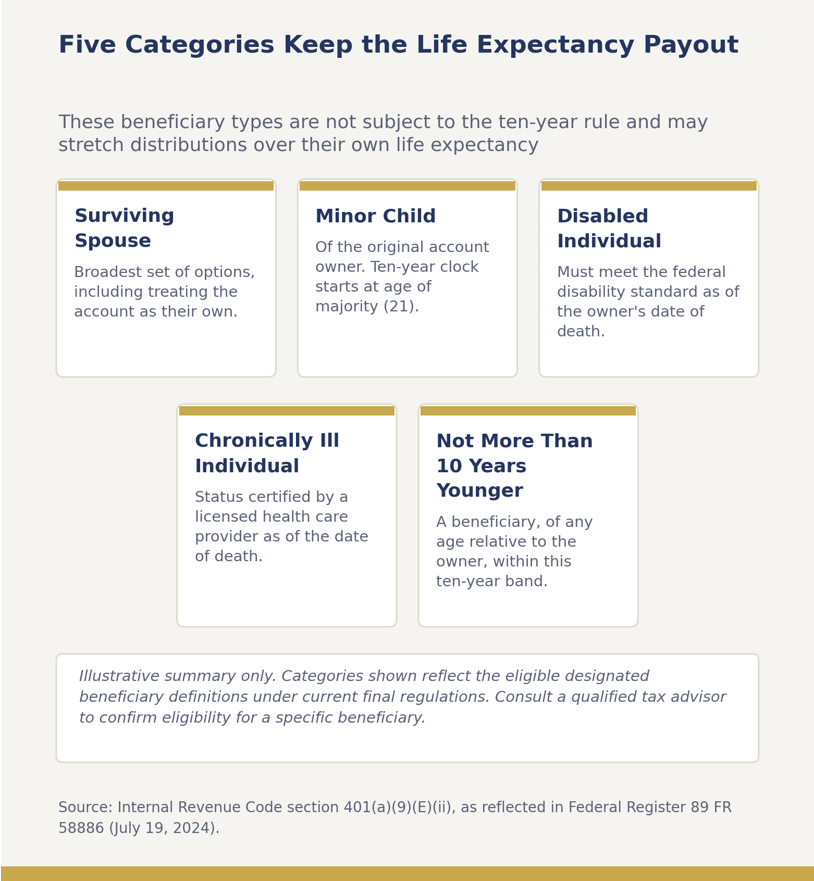
Not everyone is subject to the ten-year rule. The law carved out a category called eligible designated beneficiaries, who retain the ability to stretch distributions over their own life expectancy. Five groups qualify: a surviving spouse, a minor child of the original account decedent, a person who is disabled, a person who is chronically ill, and a beneficiary who is not more than ten years younger than the account decedent[8].
The minor child exception has a built-in expiration. Once that child reaches the age of majority, defined as 21 under the final regulations, the ten-year clock starts running on whatever balance remains[9]. The disabled and chronically ill categories require documentation of that status as of the date of the decedent’s death, filed with the plan administrator by a set deadline the following year. A beneficiary who becomes disabled after the decedent’s death does not qualify retroactively. Given how fact-specific these categories are, this is an area where a conversation with an advisor early, rather than after distributions have already started, tends to save the most trouble.
Spouses Face a Different Set of Choices
Surviving spouses occupy their own category entirely, with more flexibility than any other beneficiary, and they generally choose between two paths.
Rolling the account into their own IRA treats it as if it had always been theirs. Their own required beginning distribution date applies, rather than any date tied to the decedent. The tradeoff is that withdrawals before age 59 1/2 face the same early withdrawal penalty that applies to any IRA they’d contributed to themselves, a penalty that does not apply under the alternative below.
Keeping the account as an inherited IRA differs in a few concrete ways. If the decedent died before their required beginning distribution date, the surviving spouse can delay distributions until the year the decedent would have reached the applicable age, an option not available after a rollover[10]. Withdrawals also carry no early withdrawal penalty at any age, unlike a rollover. Once distributions begin, the amount owed is recalculated annually based on the surviving spouse’s current age, a rule that holds even when the decedent was younger than the surviving spouse[11],[12].
Which path makes sense depends heavily on the surviving spouse’s age, tax bracket, and need for access to the funds.
Where Trusts Complicate the Picture
Naming a trust as beneficiary of a retirement account is common in estate planning, but it introduces an extra layer of classification. The final regulations sort trusts into several types, including conduit trusts, which pass distributions straight through to a named beneficiary, and accumulation trusts, which allow a trustee to hold distributions inside the trust[13]. Each type interacts differently with the ten-year rule and the eligible designated beneficiary categories, and the details of how a trust is drafted, including how income and principal are handled, can determine whether beneficiaries get a stretched payout or a compressed one.
This is genuinely technical territory, more so than most other parts of estate planning, and it is one of the clearest cases where working alongside both an estate attorney and a financial advisor pays off, particularly for anyone updating a trust that predates the 2024 final regulations.
What This Means Going Forward
The transition period is effectively over. Penalty relief for missed annual distributions ended after 2024, and the rules as finalized in 2024 now govern every distribution year going forward[14]. For anyone holding an inherited retirement account, or naming beneficiaries on their own accounts, the practical task is simply confirming which category applies and whether distributions are on schedule. Given how much these rules have shifted since 2019, and how specific the outcome is to each family’s situation, this is a good area to revisit with an advisor, particularly if a beneficiary designation was made years ago under an older understanding of the rules.
Disclosures
This material is provided for general informational and educational purposes only. It does not constitute investment, tax, or legal advice, nor is it a recommendation to buy, sell, or hold any security or to pursue any particular strategy, and does not create a fiduciary relationship. It does not take into account the investment objectives, tax situation, or financial circumstances of any individual. Any figures, calculations, or examples used are for illustration only and do not represent actual client results or investment performance. Information is believed to be accurate as of the date of publication and is subject to change without notice.
Chatham Capital Group, Inc. is an SEC-registered investment adviser headquartered in Savannah, Georgia. Registration does not imply a certain level of skill or training. A copy of Chatham Capital Group's Form ADV Part 2A is available at adviserinfo.sec.gov. A copy of Chatham Capital Group's Form CRS is available here on our website.
Figures and thresholds governed by the Internal Revenue Code, including contribution limits and other annually adjusted amounts, change periodically. Readers should consult https://www.irs.gov/ for current figures and a qualified tax or legal advisor regarding their specific situation.
Sources
[1]Internal Revenue Service, “Retirement Plan and IRA Required Minimum Distributions FAQs,” irs.gov.
[2]Federal Register, “Required Minimum Distributions,” 89 Fed. Reg. 58886 (July 19, 2024).
[3]Internal Revenue Code section 401(a)(9)(C); Federal Register, 89 Fed. Reg. 58886 (July 19, 2024).
[4]Federal Register, 89 Fed. Reg. 58886 (July 19, 2024); effective for distribution calendar years beginning on or after January 1, 2025.
[5]Federal Register, 89 Fed. Reg. 58886 (July 19, 2024).
[6]Internal Revenue Service, Notice 2024-35.
[7]Internal Revenue Code section 4974, as amended by the SECURE 2.0 Act of 2022.
[8]Internal Revenue Code section 401(a)(9)(E)(ii).
[9]Federal Register, 89 Fed. Reg. 58886 (July 19, 2024), definition of minor child.
[10]Federal Register, 89 Fed. Reg. 58886 (July 19, 2024).
[11]Federal Register, 89 Fed. Reg. 58886 (July 19, 2024), spousal election provisions.
[12]Federal Register, 89 Fed. Reg. 58886 (July 19, 2024), determination of applicable denominator provisions.
[13]Federal Register, 89 Fed. Reg. 58886 (July 19, 2024), trust classification provisions.
[14]Internal Revenue Service, Notice 2024-35; Federal Register, 89 Fed. Reg. 58886 (July 19, 2024).