
November 2026
Many advisory firms describe themselves as independent, but the term is applied inconsistently across the industry. It commonly describes a firm that is not affiliated with a broker-dealer, which is how Cerulli Associates defines the independent registered investment adviser (RIA) channel.[1] At Chatham, independence simply comes down to who owns the firm. We are proud to be 100% partner-owned, because we believe ownership affects the families a firm serves.
This article explains how we define independence, which kinds of firms fall outside that definition, and why ownership should matter to you as a client. It also shows you how to verify any firm’s ownership yourself using its public filings.
How we define independence
We consider an advisory firm independent when it is owned entirely by the partners who work there and serve its clients, with no outside company or investor owning any part of it. In that kind of firm, you work directly with the people who make the firm’s decisions.
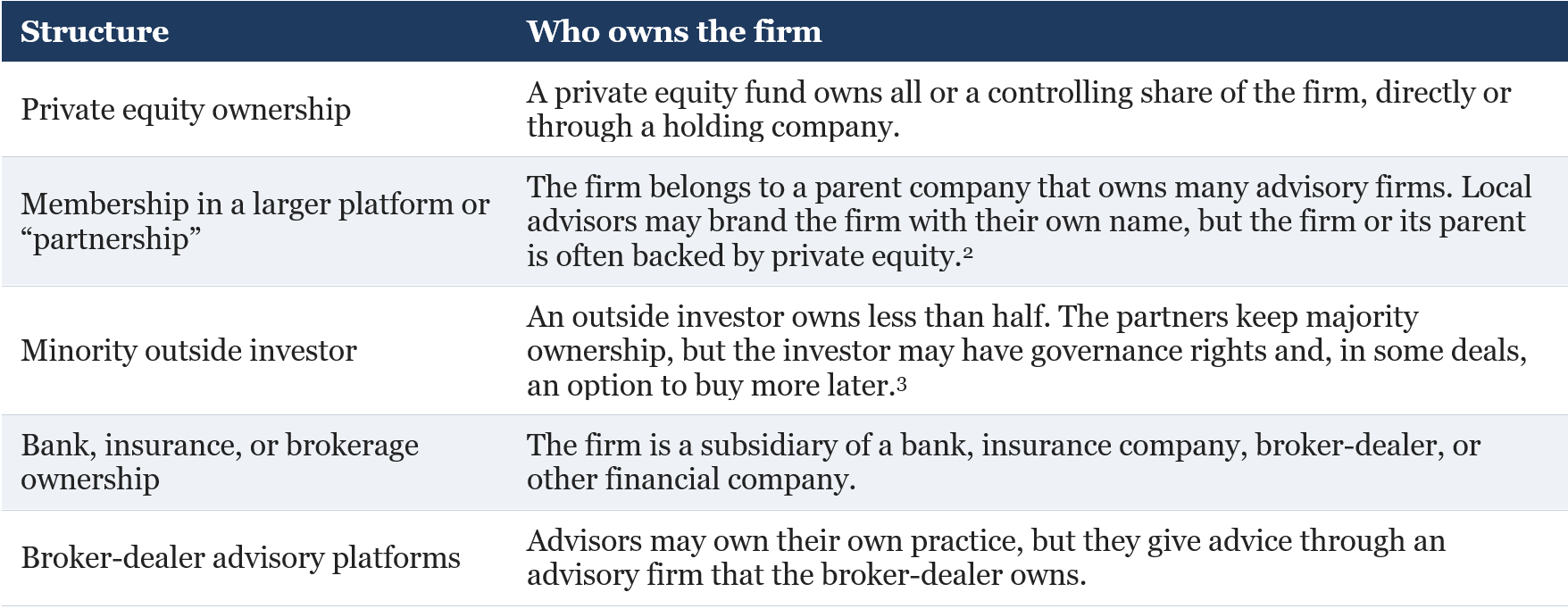
Structures outside our definition
Under our definition, several common structures are not independently owned, even when the firm is independent in the broader sense.
Why ownership matters to clients
Ownership affects clients in two ways: it determines who makes the decisions and which conflicts of interest come with the arrangement.
The people you work with do not hold final authority
In an independent firm, your advisor is also an owner. In a firm owned by someone else, your advisor answers to that owner. This affects you in three areas:
• Fees. The owner sets the fee schedule and the firm’s profit targets. Mercer Capital, a firm that values advisory businesses, notes that improving profit margins is one of private equity’s standard tools.[4] A new owner can change your fee or how fees are calculated, including through the new agreement you may be asked to sign.[5] [6]
• Investment strategy. Your advisor may still choose what you own day to day, but the owner can shape those choices through model portfolios, approved product lists, and firm policies. New model portfolios can include funds and other investment products that the owner promotes, and those products can carry additional fees on top of your advisory fee. Moving into them can also mean selling investments with large, unrealized gains, which could create a significant tax bill.4 5 [7] [8]
• Firm management. Decisions about hiring, team structure, marketing, and technology can rest with the owner. The advisors you know may have limited control over how the firm is run.4 5
Conflicts of interest
A parent company may own more than advisory firms. It may also own insurance agencies, private investment funds, broker-dealers, or lending and cash management programs, or it may have fee-sharing arrangements with them. When clients use those businesses, the parent earns more, and sometimes the advisory firm or the advisor does too.[9]
That creates an incentive to recommend the products and services the owner earns revenue from. Examples include a private fund managed by another firm the parent owns, an insurance policy placed through the parent’s insurance agency,[10] or a securities-backed loan from the parent’s lending program.[11] Advisors may also earn commissions on insurance or annuities, or bonuses tied to sales or new accounts.[12]
Firms must disclose these conflicts.[13] Disclosing a conflict does not remove it, so it is worth understanding before you act on a recommendation. These conflicts are not limited to firms with outside owners, but an outside owner can add more of them.
The growth of outside ownership
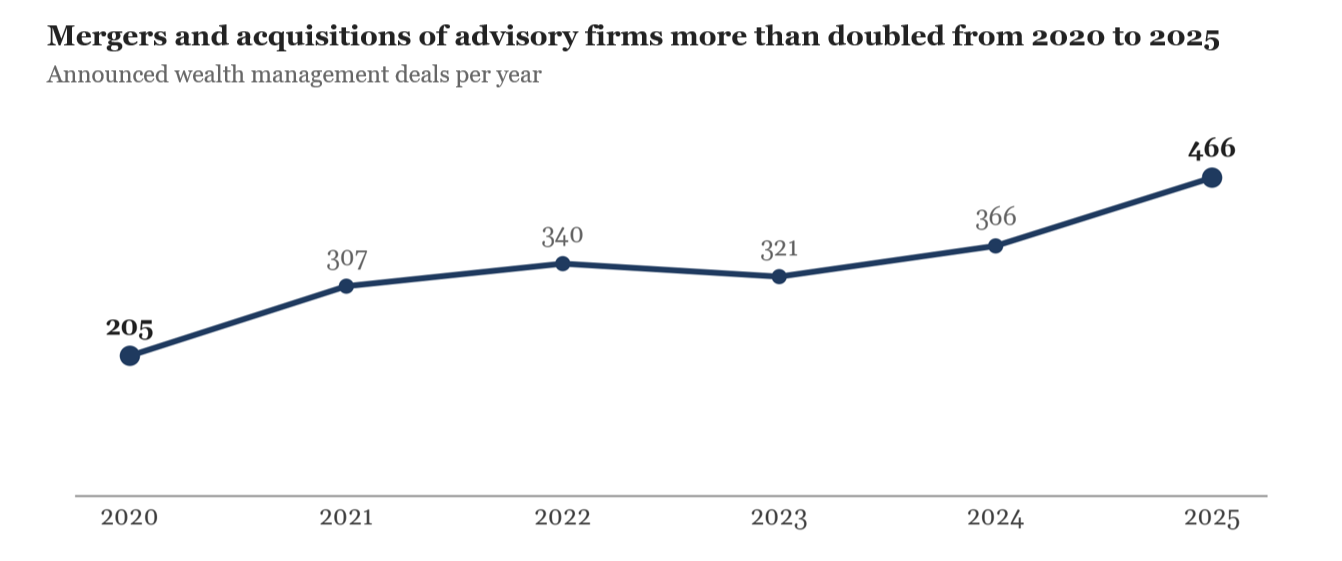
Echelon Partners, an investment bank that tracks these deals, counted 205 announced transactions in wealth management in 2020.[14] By 2025, that number had grown to 466, the most on record.[15]
Two factors help explain this activity:
• Age. In its third-quarter 2026 report, Cerulli Associates found that about 35% of financial advisors expect to retire within the next ten years, and 27% of those advisors said they were unsure of their succession plans.[18] For a founder without a successor, selling the firm is one way to transition out of the business.
• Outside capital. Advisory firms collect steady, recurring fees, which makes them attractive to buyers.4 Private equity in particular has actively pursued that revenue, and in 2025, Echelon found that 75.8% of deals involved a private equity firm or other financial sponsor, either as a direct investor or as the backer of the firm doing the buying.15
Clients may learn about a sale through a notice saying their long-time advisory firm is “joining a larger company” or “partnering” with an outside investor, which means a sale of all or part of the firm. These notices may say your advisor will remain in place and your day-to-day experience will not change. Some request your signature, while others say your agreement continues unless you object by a certain date, so read the notice carefully for any deadline.
How to verify a firm’s ownership
Every SEC-registered advisor publishes a brochure that describes its business. Item 4 of that brochure has to identify who owns the firm. Firms must name anyone who owns 25% or more, and some name every owner.[19] Here is how to find it:
1. Go to adviserinfo.sec.gov, the SEC’s Investment Adviser Public Disclosure website.
2. Select “Firm,” type the advisor’s firm name into the search box, and select the firm from the results.
3. On the firm’s page, find “Part 2 Brochures” and open the most recent brochure.
4. Scroll to Item 4, “Advisory Business.” This section describes who owns the firm.
The first example below is from Chatham’s own brochure, quoted as filed with the SEC. The second is a composite based on language found in other firms’ brochures. Its names are placeholders.
Example 1: An independent firm
“Chatham Capital Group’s principal office is in Savannah, GA, with a second office on Hilton Head Island, SC. The firm was founded in 1996 by Frederick L. Muller; L. Guy Palmer, II; and Bruce D. Fielitz. Chatham has been a registered investment adviser with the Securities and Exchange Commission since 1996. Chatham has always been 100% owned by its operating principals. The present owners are Frederick R. Muller, Philip B. Palmer, William J. Fielitz, Jason G. Allen, and Blake H. Bethea. All principals act as portfolio managers.” [20]
What this tells you:
• Every owner is a named person.
• Every owner works at the firm as a portfolio manager.
• No outside company or investor has ever owned any part of the firm.
• Ownership has already passed from the founders to the current principals without a sale to an outside owner.
Example 2: A firm described as independent but owned by someone else
Parent A describes itself as a partnership of independent wealth management firms. Firm A is part of the Parent A partnership. Firm A was controlled by its founder until it joined Parent A. It is now a wholly owned subsidiary of Parent A Holdings, LLC, which is majority owned by investment vehicles affiliated with Investment Firm, LLC. Firm A’s founder, Advisor A, continues as managing partner and CEO. Advisor A and Advisor B manage the firm under a management agreement.
What this tells you:
• “Partnership of independent wealth management firms” uses “independent” to mean the firms are run by their own advisors day to day, not that they are owned by them.
• “Part of the Parent A partnership” means membership in a network of firms, not ownership by the partners.
• “Wholly owned subsidiary” means another company owns 100% of the firm.
• “Investment vehicles affiliated with Investment Firm” means the parent company is controlled by investment funds, typically private equity.
• “Continues as managing partner and CEO” and “manage the firm under a management agreement” mean the advisors you meet still run the firm day to day, but under a contract with the owner. They no longer own it or have the final say.
Questions to ask your advisor
• Who owns the firm today, and has that changed in the past five years?
• Does an outside investor own part of the firm or its parent company? Can it buy more, and when does it expect to sell?
• Is the firm affiliated with a broker-dealer, bank, or insurance company?
• Does the firm, its parent, or my advisor earn anything beyond my advisory fee from what is recommended to me?
• Who will be my primary advisor over the next few years?
Outside ownership is not inherently bad for clients. A larger parent can bring deeper resources, added services such as tax and estate planning, and a succession path for a founder without a successor.15 Independent ownership has limits too: a smaller firm depends on fewer people, and its continuity depends on its own succession planning. The point is not that one structure is always better, but that you should know who owns your advisor and how that ownership shapes decisions.
Our commitment to independence
Chatham Capital Group was founded in Savannah in 1996 and has never been sold. Ownership has passed through internal succession from our three founders to the five partners who own the firm today, and it has always stayed with the people serving our clients.
We apply this standard to ourselves. All five of our owners work at the firm, and we are paid through advisory fees rather than commissions on the products we recommend. Our brochure is public, and Item 4 lists every owner by name. You can check it the same way you would check any other firm.
We intend to remain independently owned by the people who serve our clients.
Independence keeps decisions about clients with the partners who serve them. No outside investor sets our revenue targets or imposes a timetable for selling the firm. For families, that protects continuity: there is no outside owner whose sale could interrupt our relationship, and when an advisor eventually retires, our partners aim to plan that transition around the family’s needs.
Our ownership disclosures are available through our SEC adviser profile at adviserinfo.sec.gov/firm/summary/106174.
Important Disclosures
This article is provided for informational and educational purposes only and does not constitute investment, tax, or legal advice, or a recommendation to buy, sell, or hold any security or to adopt any strategy. Reading this article does not create an advisory or fiduciary relationship. Investors should consult a qualified tax or financial advisor regarding their individual circumstances before making any decision.
Industry data cited are as of the dates noted and are subject to change. Information has been obtained from government and other sources believed to be reliable, but its accuracy and completeness are not guaranteed.
Chatham Capital Group, Inc. is an investment adviser registered with the U.S. Securities and Exchange Commission and headquartered in Savannah, Georgia. Registration does not imply a certain level of skill or training. Additional information about Chatham Capital Group, Inc., including its Form ADV Part 2A, is available at adviserinfo.sec.gov. Form CRS is available at chathamcapitalgroup.com/s/Form-CRS.pdf.
Sources
[1] Alex Ortolani, “Cerulli: Independent RIAs to outpace all other channels by 2028,” WealthManagement.com, February 13, 2025. https://wealthmanagement.com/ria-news/cerulli-independent-rias-to-outpace-all-other-channels-by-2028
[2] Leo Almazora, “RIA M&A ties second-best quarter as PE turns to minority stakes,” InvestmentNews, October 28, 2026. https://www.investmentnews.com/ria-news/ria-ma-ties-second-best-quarter-as-pe-turns-to-minority-stakes/268778
[3] Peter Nesvold, “10 Pros and Cons of Taking On a Minority-Stake Investor,” ThinkAdvisor, December 14, 2020. https://thinkadvisor.com/2020/12/14/10-pros-and-cons-of-taking-on-a-minority-stake-investor
[4] Brooks Hamner, “Private Equity Has Bid Up RIAs. Now Comes the Hard Part,” RIA Valuation Insights (blog), Mercer Capital, June 25, 2026. https://mercercapital.com/insights/blogs/ria-valuation-insights-blog/2026/private-equity-has-bid-up-rias-now-comes-the-hard-part/
[5] U.S. Securities and Exchange Commission, “Form ADV: Glossary of Terms,” SEC 1707 (07-24), s.v. “Control.” https://www.sec.gov/about/forms/formadv-instructions.pdf
[6] Investment Advisers Act of 1940, §§ 202(a)(1), 205(a)(2), 15 U.S.C. §§ 80b-2(a)(1), 80b-5(a)(2). https://www.govinfo.gov/content/pkg/COMPS-1878/pdf/COMPS-1878.pdf
[7] U.S. Securities and Exchange Commission, “Form ADV (Paper Version), Part 2: Uniform Requirements for the Investment Adviser Brochure and Brochure Supplements,” SEC 1707 (08-22), Items 5.C and 11.B. https://www.sec.gov/files/form-adv-part2.pdf
[8] Internal Revenue Service, “Topic No. 409, Capital Gains and Losses.” https://www.irs.gov/taxtopics/tc409
[9] U.S. Securities and Exchange Commission, “Form ADV, Part 2,” Items 5.E, 10.C, and 14.A.
[10] U.S. Securities and Exchange Commission, “Form ADV, Part 2,” Items 10.C and 11.B.
[11] U.S. Securities and Exchange Commission, Office of Investor Education and Advocacy, and Financial Industry Regulatory Authority, “Investor Alert: Securities-Backed Lines of Credit,” December 21, 2015. https://www.investor.gov/introduction-investing/general-resources/news-alerts/alerts-bulletins/investor-alerts/investor-28
[12] U.S. Securities and Exchange Commission, “Form ADV, Part 2,” Part 2A Item 5.E; Part 2B Items 4.A.2 and 5.
[13] U.S. Securities and Exchange Commission, “Form ADV, Part 2,” General Instruction 3.
[14] “Fourth quarter saw a record 69 RIA deals, Echelon says,” InvestmentNews, December 23, 2020. https://www.investmentnews.com/industry-news/fourth-quarter-saw-a-record-69-ria-deals-echelon-says/200750
[15] Leo Almazora, “Echelon Partners: Billion-dollar RIA deals boomed in 2025,” InvestmentNews, February 13, 2026. https://www.investmentnews.com/ria-news/echelon-report-billion-dollar-ria-deals-boomed-in-2025/265280
[16] Jeff Benjamin, “Private equity influence on wealth management is big and getting bigger,” InvestmentNews, February 2, 2022. https://www.investmentnews.com/alternatives/private-equity-influence-on-wealth-management-is-big-and-getting-bigger/216705
[17] Bruce Kelly, “It’s a seller’s market for RIAs in 2025, report says,” InvestmentNews, January 21, 2025. https://www.investmentnews.com/practice-management/its-a-sellers-market-for-rias-in-2025-report-says/258991
[18] “Adviser recruitment, development gain importance as retirements rise,” PLANADVISER, August 7, 2026. https://www.planadviser.com/adviser-recruitment-development-gain-importance-as-retirements-rise/
[19] U.S. Securities and Exchange Commission, “Form ADV, Part 2,” Item 4.A.
[20] Chatham Capital Group, Inc., “Form ADV Part 2A: Firm Brochure,” Item 4.A, March 31, 2026. https://adviserinfo.sec.gov/firm/brochure/106174