
The Value of Letting Wealth Compound
Sometimes the best move an investor can make is no move at all.
Protecting the Compounding Engine
When a portfolio contains a stock with a very low-cost basis and a large, unrealized gain, it can be tempting to think of the position as 'stale,' as though its long, uninterrupted growth means it has simply been left alone. This is particularly true if it has been held for many years. However, a lack of trading should not be confused with a lack of investment discipline. In many cases, allowing a high-quality asset to continue compounding can be more valuable than realizing a large taxable gain simply to put the proceeds into something that appears more attractive today.
Active Trading Often Leads to Lower Returns
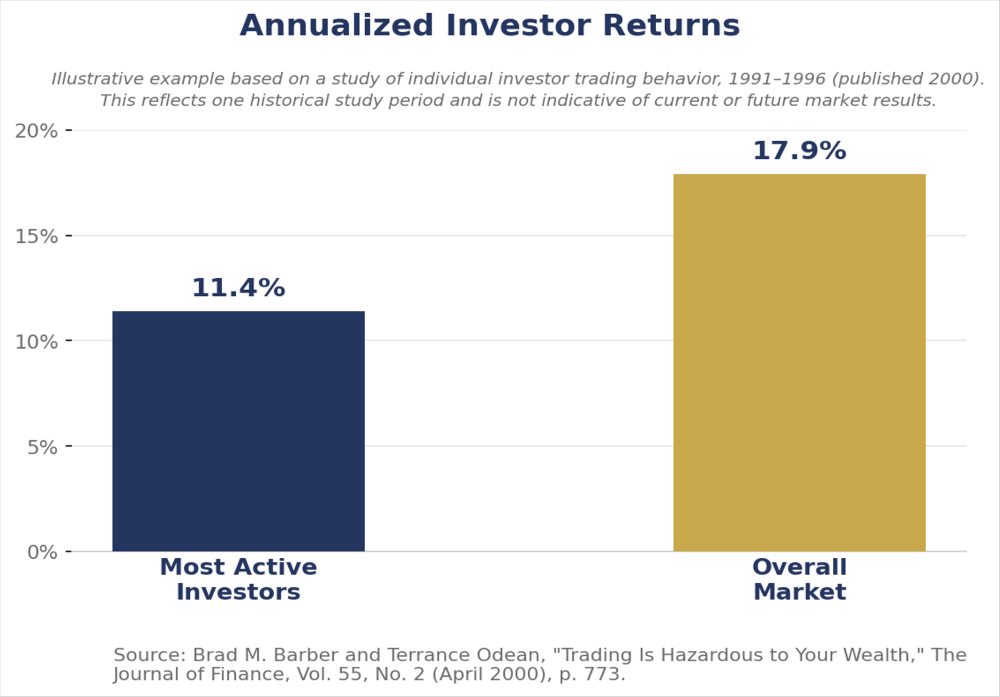
Research has consistently demonstrated the potential cost of excessive activity. In their widely cited study from 2000, Trading Is Hazardous to Your Wealth, Brad Barber and Terrance Odean examined more than 66,000 households and found that the investors who traded most earned substantially less than those who traded least. The most active investors earned an annualized 11.4%, compared with 17.9% for the market during the study period.[1] More recently, Morningstar's 2024 'Mind the Gap' study found that over the decade ending on December 31, 2023, investors who transacted less frequently, often because they held diversified, automatically rebalanced funds, captured a greater share of their funds' total returns than those in narrower, higher-turnover strategies.[2]
The Important of Holding on to Winners
Holding on to winning stocks can be difficult, particularly when a position has become a large part of a portfolio. Yet long-term market gains are often driven by a surprisingly small number of extreme outperformers.
Research by Hendrik Bessembinder, a professor at Arizona State’s W.P. Carey School of Business, shows that most individual stocks fail to outperform risk-free Treasury bills, while a relatively small group of superstar companies has accounted for virtually all net wealth creation in the U.S. stock market.[3] Because the distribution of stock returns is so highly skewed, selling top performers too early can eliminate exposure to the very companies responsible for outsized long-term results.[4]
Investors often describe this behavioral tendency as “cutting the flowers and watering the weeds”, which means selling investments that have performed well while continuing to hold investments that have disappointed.[5]
However, holding a winner does not mean ignoring the risks that come with success. As a position grows, portfolio diversification becomes increasingly important. This does not necessarily mean the winner should be sold, but that the rest of the portfolio should be managed around it.
A thoughtful diversification strategy can help protect the overall portfolio while preserving exposure to a high-conviction, high-performing asset:
Diversify around the winner: New capital and portfolio contributions can be directed toward other asset classes, sectors and securities rather than continuing to increase the concentration.
Manage the surrounding risks: The portfolio can be evaluated for liquidity needs, income requirements, volatility, correlation and other exposures that may become more important as the position grows.
Use tax-aware rebalancing: Where appropriate, gains can be realized gradually or strategically rather than triggering a large tax bill simply to bring a portfolio back to an arbitrary target allocation.
Define the limits in advance: Having a framework for when concentration becomes unacceptable can prevent emotion from driving the decision later. A position does not have to be sold simply because it has become larger.
The objective is not to let a successful investment dominate the portfolio without consideration. It is to preserve the potential of the compounding asset while managing the risks that surround it.
Activity is Not the Same as Progress
Perhaps most importantly, investors should not equate activity with good stewardship. A portfolio does not need to generate a constant stream of transactions to be actively managed in the investor's best interest.
Behind the scenes, significant analysis and monitoring can be taking place even when a position is not being sold or actively traded. This means continually evaluating the underlying investment, valuation, concentration, risk, tax implications, portfolio role and potential alternatives.
Sometimes that analysis leads to a transaction. Sometimes it leads to the conclusion that doing nothing is the better decision. The objective is not to maximize the number of decisions made, but instead to maximize the quality of those decisions.
For long-term investors, wealth creation is ultimately about allowing capital to compound while managing risk and taxes intelligently. A low-basis position that has appreciated substantially may look "stale" on a statement, but it may actually be one of the most valuable assets in the portfolio.
True wealth management is not defined by a single decision to buy, sell, or hold. It may mean selling. It may mean trimming. It may mean diversifying around a concentrated position. Sometimes it may mean doing nothing at all. The right course depends on the investor's full financial picture, not just the fate of one position.
Taxes Can Make “Moving On” Surprisingly Expensive
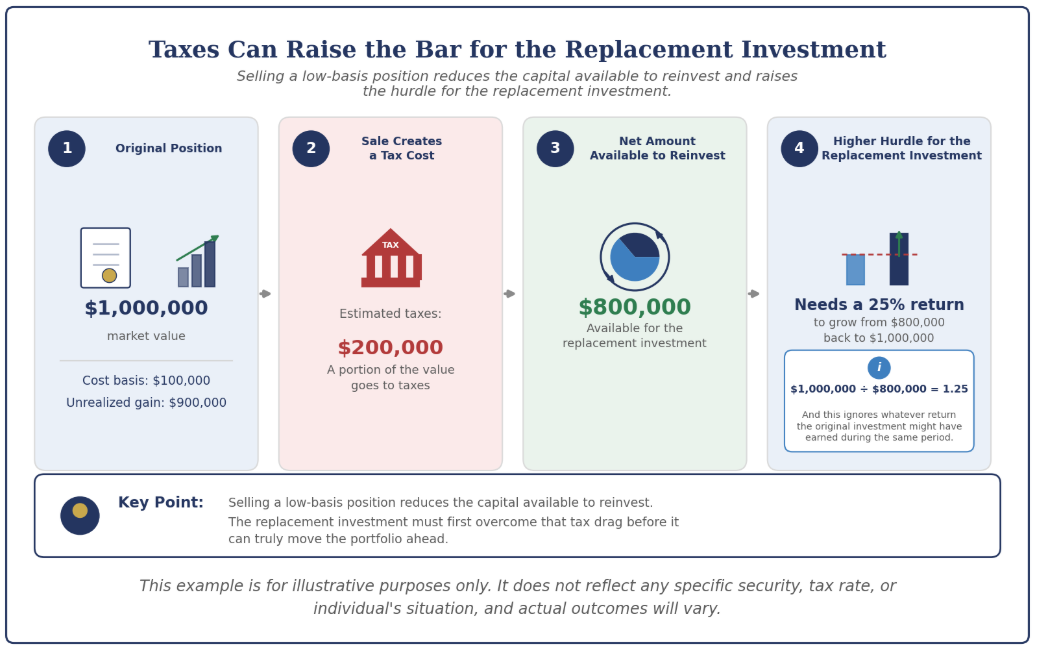
Selling a low-basis position can create a substantial capital-gains tax liability. That means the full market value of the position is not available to reinvest. A portion of the portfolio’s value may effectively be transferred to the government, creating a higher hurdle for the replacement investment.
For example, imagine a $1 million position with a $100,000 cost basis. If selling the position results in $200,000 of taxes, only $800,000 remains available for reinvestment.
That replacement investment would need to generate a 25% return simply to grow from $800,000 back to $1 million. That is before considering the return the original investment might have generated during the same period. This example is for illustrative purposes only. It does not reflect any specific security, tax rate, or individual’s situation, and actual outcomes will vary.
The precise tax impact varies by investor circumstances, including the applicable tax rates, holding period and other factors. But the principle is important: the decision to sell should account for both the investment thesis and the tax cost of getting there.
Alternative to an All-or-Nothing Decision
Holding a low-basis position does not necessarily mean simply accepting concentration risk indefinitely. Depending on the circumstances, there may be strategies that can address concentration, generate income, manage risk or ultimately facilitate an exit while remaining mindful of taxes.
Gradual diversification: Rather than making a single, large sale, investors may be able to diversify over time, using tax-aware decisions to gradually reduce concentration while retaining meaningful exposure to a long-term winner.
Charitable giving: For investors with philanthropic goals, donating appreciated securities can be an especially efficient way to put a low-basis position to work. Under applicable rules, qualifying appreciated property donated to charity may generally be deductible at fair market value, subject to various limitations and requirements.
Covered calls: Selling call options against a position can generate premium income while potentially creating a mechanism for selling the stock at a predetermined price. The option premium may help offset some of the economic cost associated with realizing the gain, although covered calls involve important tax, risk and opportunity-cost considerations.
Hedging: In appropriate circumstances, a concentrated position can potentially be hedged using derivatives or other strategies. Hedging can reduce certain risks without immediately triggering the capital gain associated with selling the underlying shares, although it introduces its own costs, risks and potential tracking issues.
These strategies are not appropriate in every situation. The right answer depends on the security, concentration, tax basis, time horizon, risk tolerance, charitable intentions and broader financial plan.
Ultimately, the goal is not simply to decide whether to hold or sell. It is to determine how best to balance compounding, diversification, risk and taxes in the context of the investor’s entire financial picture.
Important Disclosures
This material is provided for general informational and educational purposes only. It does not constitute investment, tax, or legal advice, nor is it a recommendation to buy, sell, or hold any security or to pursue any particular strategy, and does not create a fiduciary relationship. It does not take into account the investment objectives, tax situation, or financial circumstances of any individual. Any figures, calculations, or examples used are for illustration only and do not represent actual investor results or investment performance. Information is believed to be accurate as of the date of publication and is subject to change without notice.
Chatham Capital Group, Inc. is an SEC-registered investment adviser headquartered in Savannah, Georgia. Registration does not imply a certain level of skill or training. A copy of Chatham Capital Group's Form ADV Part 2A is available at adviserinfo.sec.gov. A copy of Chatham Capital Group's Form CRS is available here on our website.
Figures and thresholds governed by the Internal Revenue Code, including contribution limits and other annually adjusted amounts, change periodically. Readers should consult https://www.irs.gov/ for current figures and a qualified tax or legal advisor regarding their specific situation.
Sources
[1] Brad M. Barber and Terrance Odean, "Trading Is Hazardous to Your Wealth: The Common Stock Investment Performance of Individual Investors," The Journal of Finance, Vol. 55, No. 2 (April 2000), p. 773.
[2] Morningstar, "Mind the Gap 2024: A Report on Investor Returns in the United States," (2024), Conclusion and Lessons From the Study. Available at https://www.morningstar.com/lp/mind-the-gap.
[3] Hendrik Bessembinder, "Do Stocks Outperform Treasury Bills?" Journal of Financial Economics (forthcoming 2018), Abstract and Conclusion. Available at Social Science Research Network, https://papers.ssrn.com/sol3/papers.cfm?abstract_id=2900447.
[4] Bessembinder, "Do Stocks Outperform Treasury Bills?" p. 36 (noting that poorly diversified portfolios underperform because they omit the relatively few stocks that generate large positive returns). The application of this finding to the sale of an existing position reflects the same underlying principle of return concentration.
[5] Peter Lynch, One Up On Wall Street: How To Use What You Already Know to Make Money in the Market, First Simon & Schuster Trade Paperback Edition (New York: Simon & Schuster, 2026), Introduction, pp. 21–22.